01
Start with an idea.
Can released and clamped stiffnesses hide different internal support modes? Start from this paper's research question.
You get: This article's research question.

 nematiclabContact
AI research workspace
Describe your question. AI helps find sources, run calculations, and prepare a manuscript. You review the science and export the article.
See how it worksProduct preview. Public access will follow a future release.
Follow the elastic-mode article through NematicLab.
01
Can released and clamped stiffnesses hide different internal support modes? Start from this paper's research question.
You get: This article's research question.
02
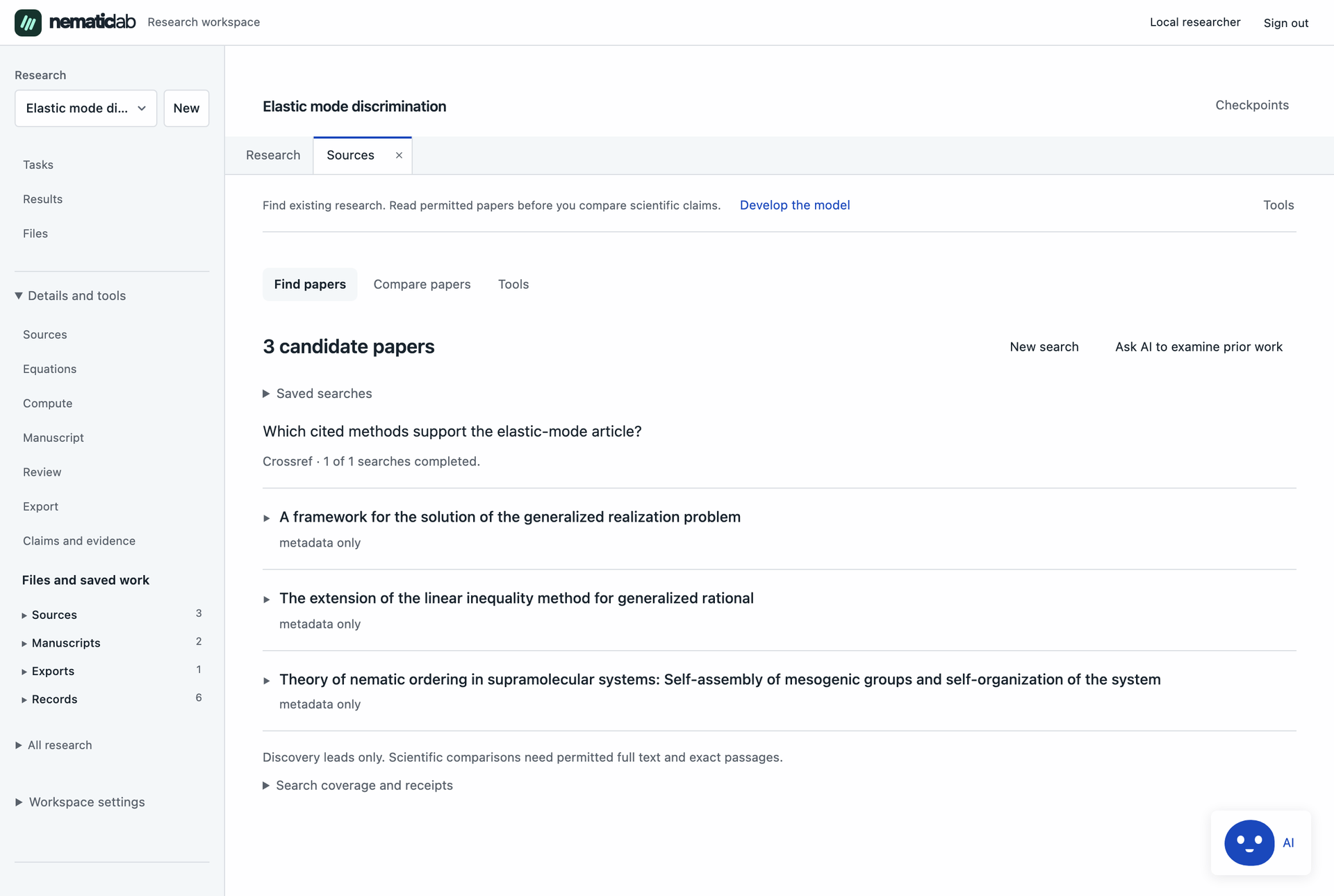
Find the paper's references on nematic ordering, Loewner theory, and rational approximation.
You get: References from the actual article.
03
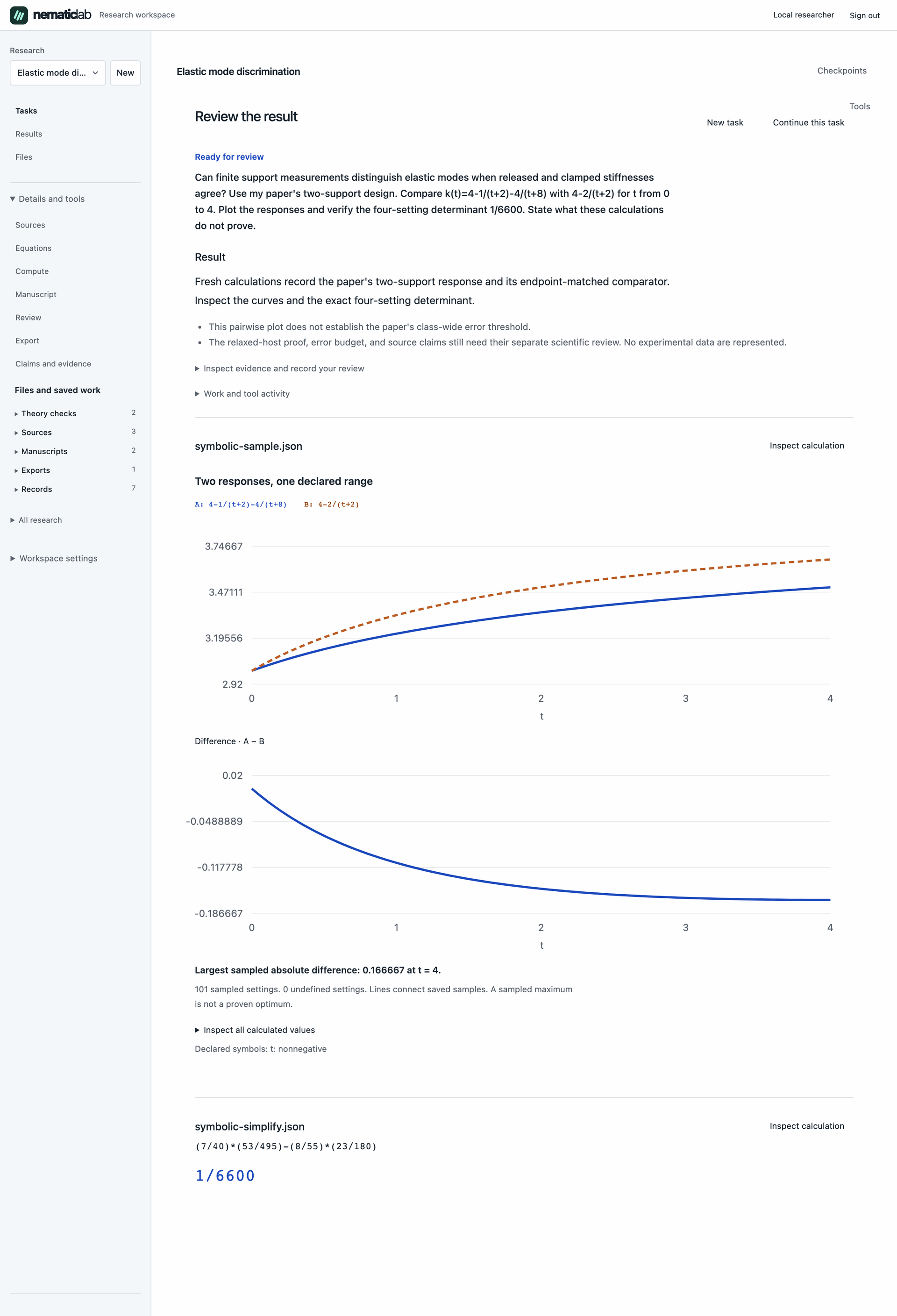
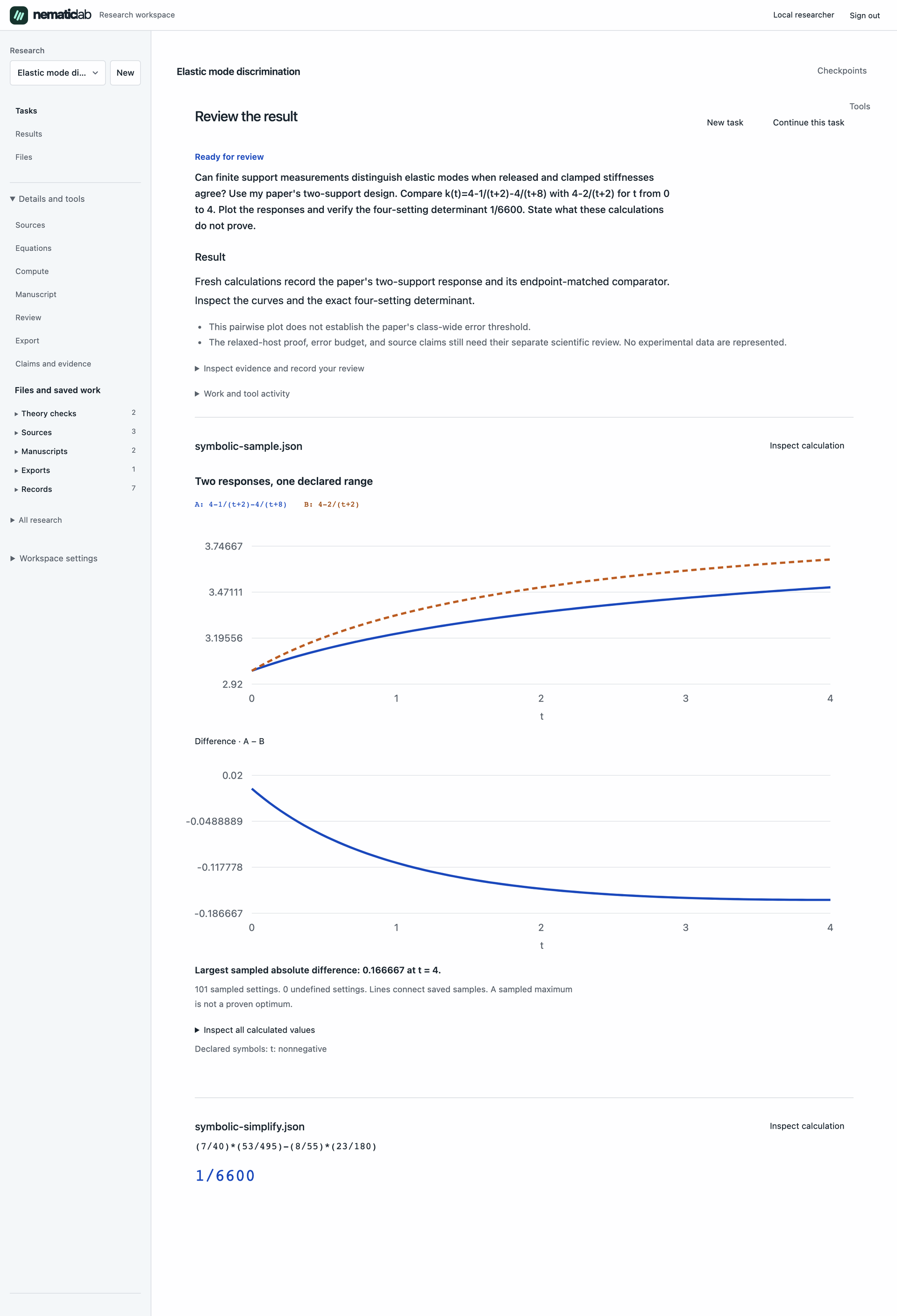
Recalculate its two-support response. Compare the endpoint-matched model and examine the exact four-setting determinant.
You get: The response curves and determinant.
04
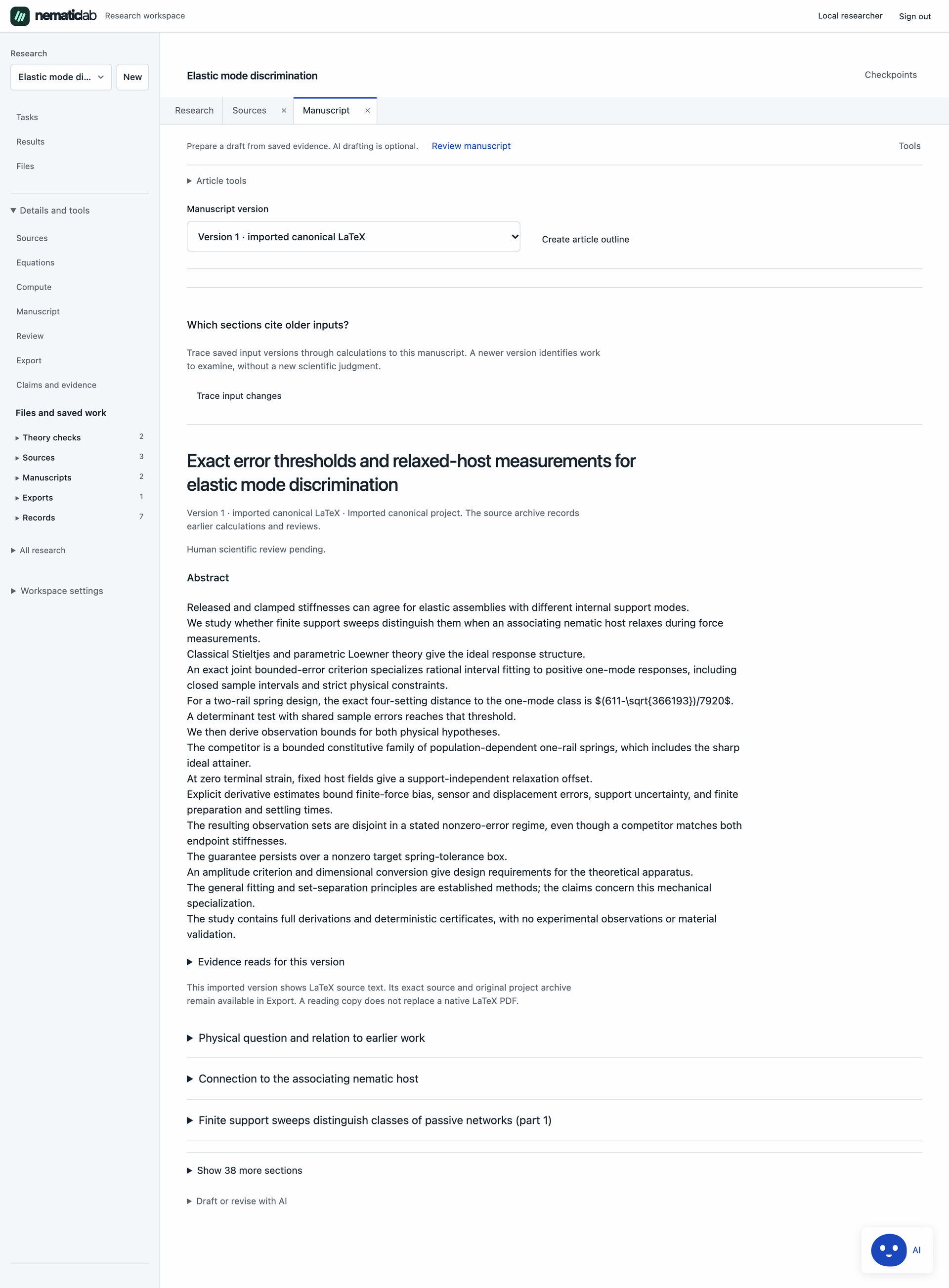
Open the actual article, with its title, abstract, equations, and references. Keep the source version intact.
You get: The imported article in its research project.
05
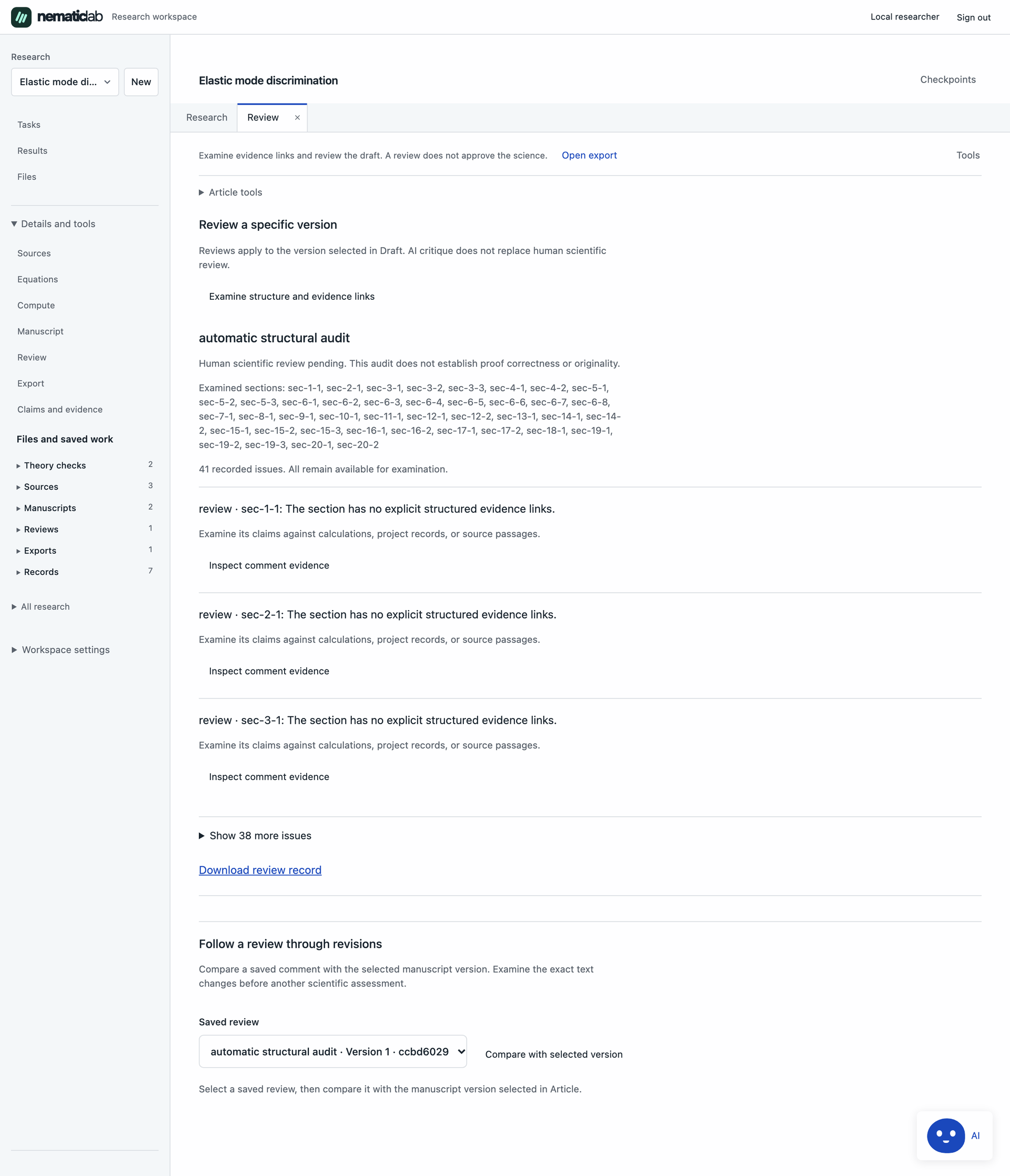
Examine that manuscript's structure and evidence links. Keep unresolved scientific questions visible.
You get: A review tied to this manuscript.
06
Prepare that article and its private evidence package. Public previews show selected pages only.
You get: The article and its private supporting records.
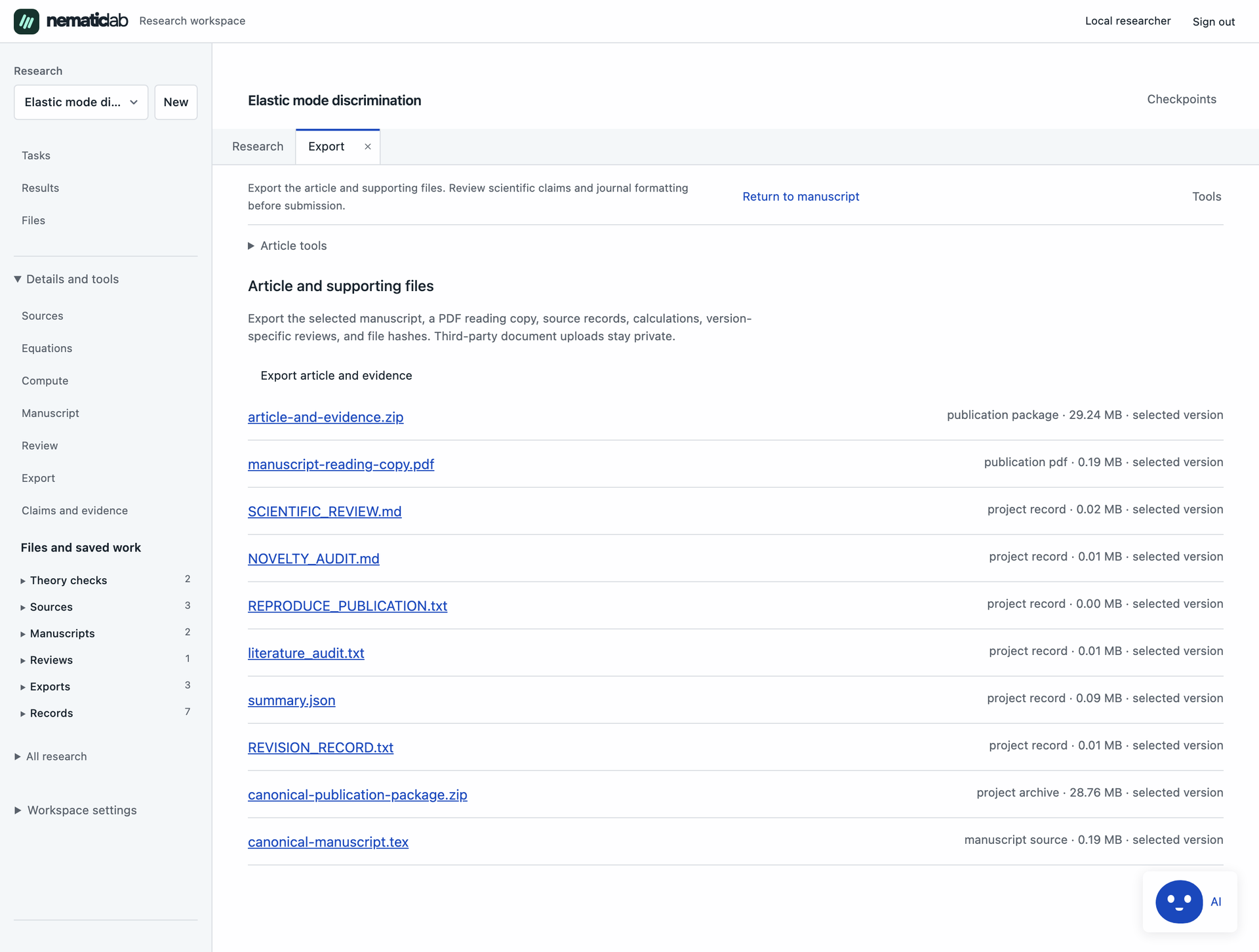
Actual app replay of this article. Bibliography and manuscript imported. Calculations run again with scripted AI. Scientific review remains pending.
A real research article
The screenshots follow this article through NematicLab. Only selected pages and the abstract are public.
The study compares elastic models, derives error thresholds, and preserves the argument through references and mathematical appendices.
Released and clamped stiffnesses can agree for elastic assemblies with different internal support modes. We study whether finite support sweeps distinguish them when an associating nematic host relaxes during force measurements. Classical Stieltjes and parametric Loewner theory give the ideal response structure. An exact joint bounded-error criterion specializes rational interval fitting to positive one-mode responses, including closed sample intervals and strict physical constraints. For a two-rail spring design, the exact four-setting distance to the one-mode class is (611 − √366193)/7920. A determinant test with shared sample errors reaches that threshold. We then derive observation bounds for both physical hypotheses. The competitor is a bounded constitutive family of population-dependent one-rail springs, which includes the sharp ideal attainer. At zero terminal strain, fixed host fields give a support-independent relaxation offset. Explicit derivative estimates bound finite-force bias, sensor and displacement errors, support uncertainty, and finite preparation and settling times. The resulting observation sets are disjoint in a stated nonzero-error regime, even though a competitor matches both endpoint stiffnesses. The guarantee persists over a nonzero target spring-tolerance box. An amplitude criterion and dimensional conversion give design requirements for the theoretical apparatus. The general fitting and set-separation principles are established methods; the claims concern this mechanical specialization. The study contains full derivations and deterministic certificates, with no experimental observations or material validation.
50-page research draft · No experimental data · Scientific approval pending
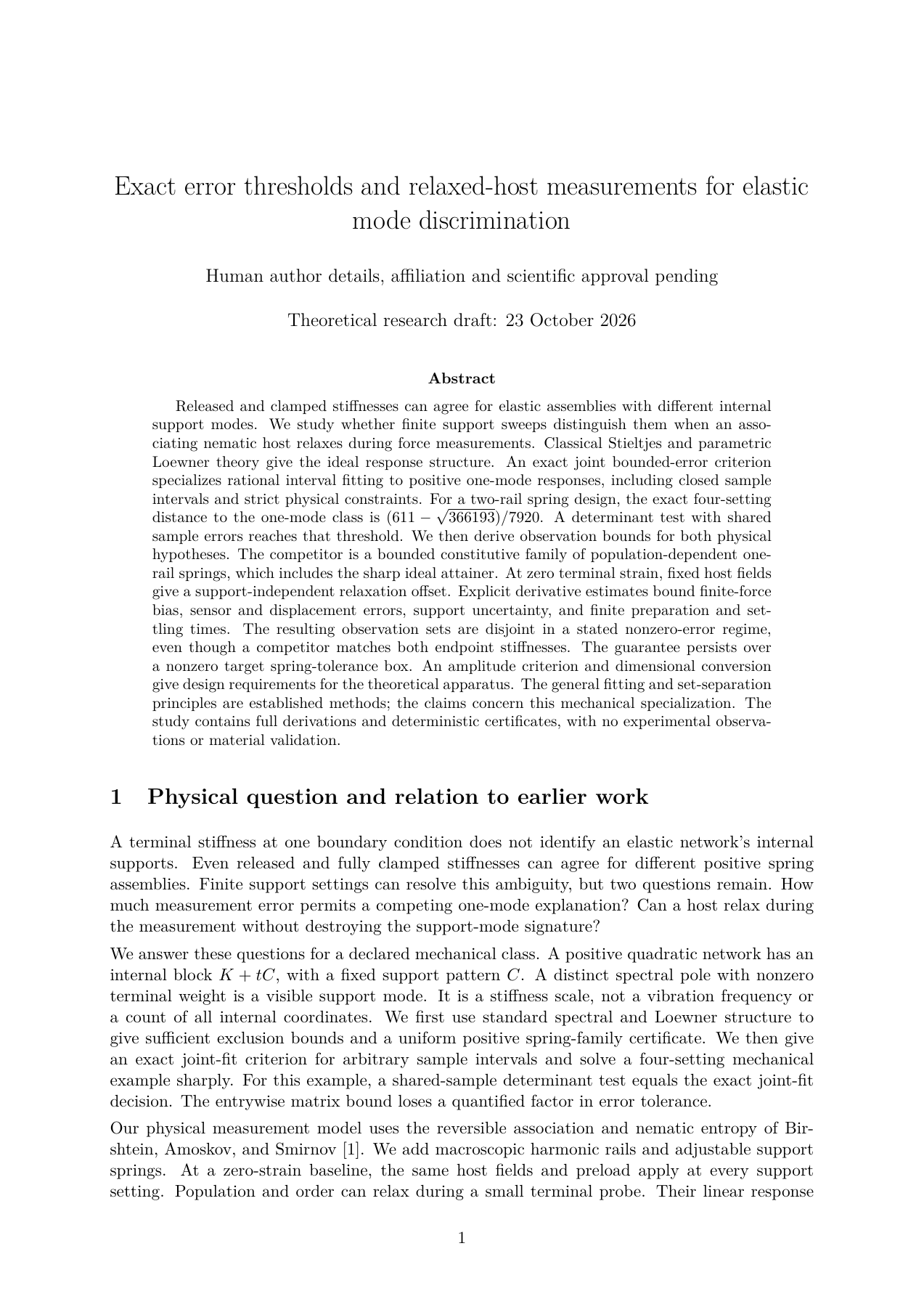
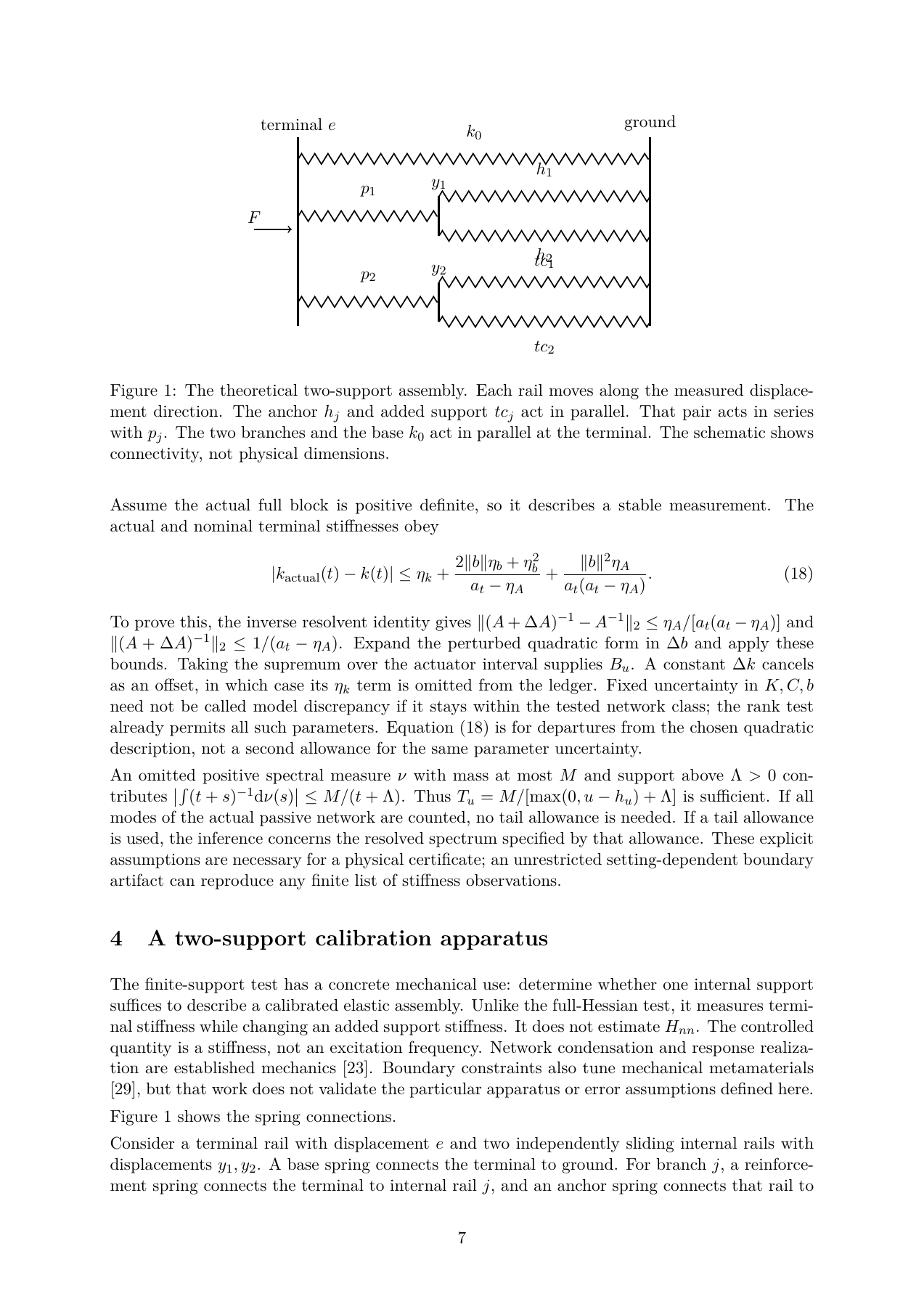
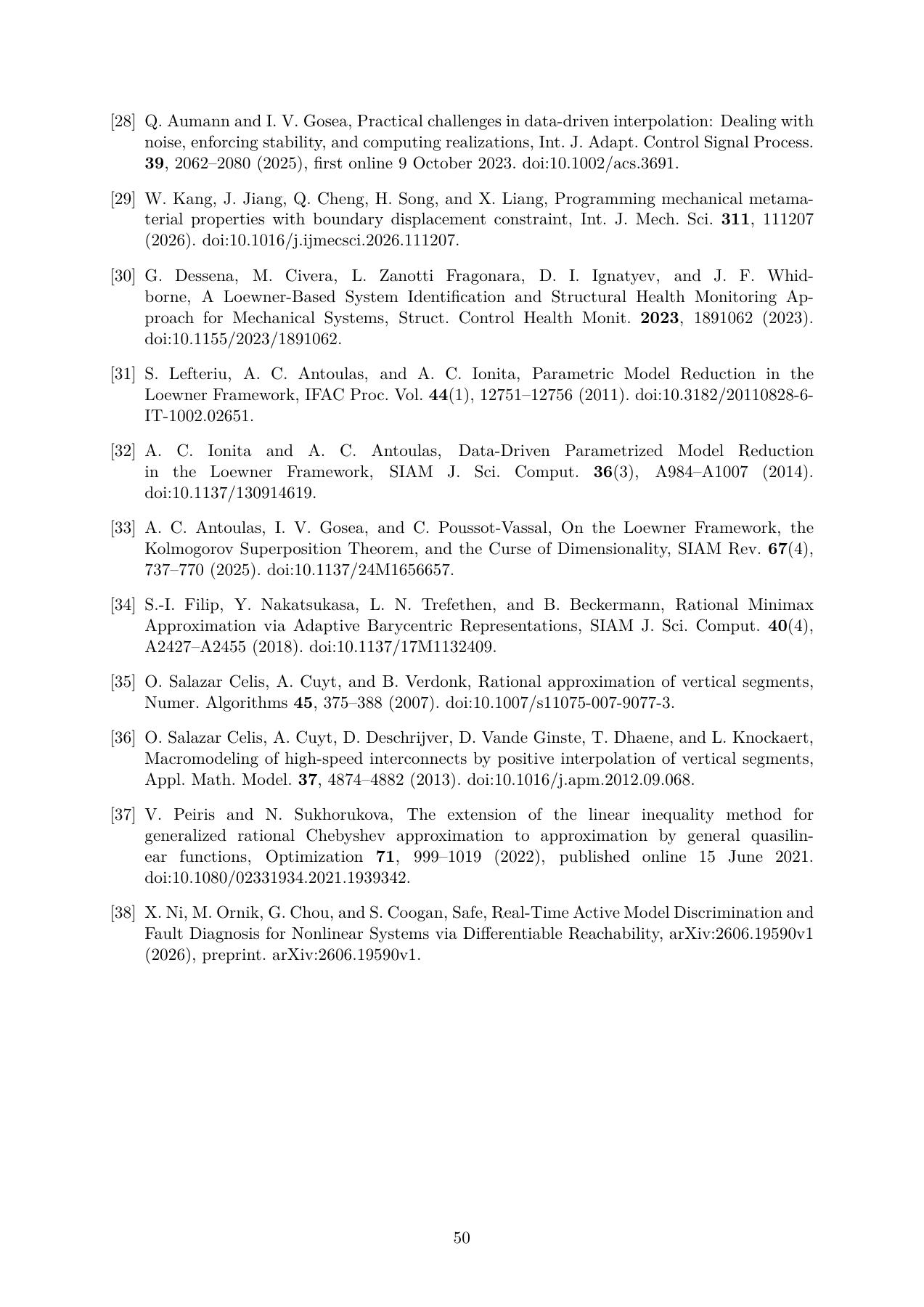
Selected pages and abstract from the current research draft. The complete paper is not available on this site.
AI uses literature sources and scientific tools through the analysis service. Results return to the same study.
Your sources, calculations, figures, and manuscript stay connected. Experimental data is optional.